

If you're planning to manufacture anti-slip elastic tapes, lace trims, bra straps, sportswear elastic bands, or other silicone-coated textile products, one of the first questions you'll face is:
Should you use single-component silicone or two-component silicone?
Many companies entering the textile accessories industry assume that the difference lies only in the silicone material itself. In reality, the curing method of the silicone determines the entire production process—including the design of the silicone coating machine, the production efficiency, coating quality, and even the long-term operating cost.
At YM Machinery, we often receive inquiries from manufacturers looking for an Elastic Tape & Lace Silicone Coating Machine. Some customers plan to produce small batches of decorative silicone patterns, while others need a reliable solution for large-scale production of anti-slip elastic tapes with excellent wash durability.
Although both single-component and two-component silicones can be applied to elastic tapes and lace, they are designed for different manufacturing goals. Choosing the wrong silicone system may result in lower productivity, inconsistent curing, or unnecessary equipment investment.
This guide explains the key differences between RTV-1 (single-component) and RTV-2 (two-component addition-cure) silicone, compares their performance, and helps you select the most suitable silicone coating machine for elastic tape and lace production.
Why Does Silicone Type Determine the Machine Configuration?
Before comparing the two silicone systems, it's important to understand one fundamental principle:
The machine is designed around the silicone curing process—not the other way around.
Many first-time buyers wonder whether one machine can handle both single-component and two-component silicone. The answer is generally no.
The reason is simple:
Single-component silicone cures by absorbing moisture from the surrounding air, while two-component silicone cures through a chemical reaction that begins immediately after Components A and B are mixed.
Because these curing mechanisms are completely different, the production equipment must also be designed differently.
For example, a single-component silicone coating machine typically focuses on stable coating and gentle low-temperature drying to accelerate surface drying before rewinding. The final curing process continues naturally as the coated products are exposed to ambient humidity.
By contrast, a two-component silicone coating machine requires a precision metering and mixing system that continuously blends Components A and B in the correct ratio before coating. A high-temperature curing oven is then used to complete crosslinking within seconds, making it suitable for continuous industrial production.
Understanding this difference is the first step toward selecting the right textile silicone coating machine for your production line.
What Is Single-Component Silicone (RTV-1)?
Single-component silicone, commonly known as RTV-1 silicone, is supplied as a ready-to-use material. The base polymer, curing agent, and catalyst are already premixed by the manufacturer, allowing operators to apply the silicone directly without additional mixing equipment.
Instead of relying on chemical mixing, RTV-1 silicone cures by reacting with moisture in the surrounding air. As humidity penetrates the coating, the silicone gradually crosslinks from the surface toward the interior.
This curing mechanism makes RTV-1 extremely easy to use, especially for companies producing prototypes, customized products, or short production runs.
For elastic tape silicone coating, the recommended coating thickness is generally 0.1–0.5 mm per layer to ensure uniform curing and consistent appearance.
Typical Technical Characteristics of RTV-1 Silicone
Although formulations vary among suppliers, single-component silicone used for textile coating typically offers the following characteristics:

Because curing depends on environmental humidity, production conditions such as temperature and moisture can influence the curing speed.
Advantages of Single-Component Silicone
For many manufacturers, simplicity is the biggest advantage of RTV-1 silicone.
1. Ready to Use
No mixing is required before production.
Operators can start coating immediately after opening the container, eliminating the need for metering pumps, static mixers, or ratio adjustments.
This significantly simplifies daily production and reduces operator training requirements.
2. Lower Equipment Investment
Since no A/B mixing system is necessary, the silicone coating equipment is mechanically simpler.
The production line usually consists of:
- Unwinding system
- Silicone coating head
- Low-temperature drying chamber
- Rewinding system
- This makes it an attractive solution for startups, laboratories, and companies exploring new product lines.
3. Ideal for Frequent Product Changes
Many textile manufacturers receive orders involving:
- Small quantities
- Multiple colors
- Customized logos
- Decorative silicone patterns
- Sample development
- Single-component silicone allows quick material replacement with minimal preparation time, making it highly suitable for flexible production.
4. Excellent for Decorative Silicone Coating
RTV-1 silicone performs particularly well when producing:
- Fine silicone lines
- Decorative dots
- Brand logos
- Letters
- Fashion embellishments
- These applications typically require only thin silicone layers rather than thick anti-slip coatings.
Limitations of Single-Component Silicone
Despite its convenience, RTV-1 silicone also has several limitations that manufacturers should consider before investing in a silicone coating machine for elastic tape.
Moisture-Dependent Curing
Since curing relies on ambient humidity, production consistency may vary depending on seasonal weather and factory conditions.
Higher humidity generally accelerates curing, while dry environments may extend curing time.
Limited Thickness
Because moisture cures the silicone from the outside inward, excessively thick coatings may remain uncured internally for an extended period.
For textile applications, thin coatings are strongly recommended to achieve stable production quality.
Moderate Wash Resistance
Products coated with RTV-1 silicone generally provide satisfactory performance for decorative applications.
However, when subjected to repeated industrial laundering, their durability is typically lower than that of addition-cure silicone.
For products requiring high wash resistance, such as anti-slip bra straps or sportswear elastic, manufacturers usually choose two-component silicone instead.
Typical Applications of Single-Component Silicone
Single-component silicone is widely used in applications where production flexibility is more important than maximum durability.
Typical production orders include:
- Product sampling
- Prototype development
- Small-batch customized production
- Decorative silicone coating
- Silicone logos
- Letter printing
- Fashion trims
- Experimental product development
- R&D workshops
- These products usually involve frequent design changes and relatively short production cycles, making RTV-1 an economical and practical choice.

Suitable Materials for RTV-1 Silicone Coating
A single-component silicone coating machine is commonly used for coating a variety of textile materials, including:
- Nylon woven elastic tapes
- Polyester elastic tapes
- Satin ribbons
- Cotton webbing
- Woven labels
- Decorative lace trims
- Narrow fabrics requiring thin silicone coatings
- Heat-sensitive elastic materials that cannot withstand high curing temperatures
- These materials are generally used for decorative purposes rather than demanding anti-slip applications.
Machine Configuration for Single-Component Silicone
A Single-Component Elastic Tape & Lace Silicone Coating Machine is specifically designed for moisture-curing silicone.
Unlike production lines for addition-cure silicone, this machine does not require an A/B metering system or a static mixer.
A typical production process includes:
Unwinding → Silicone Coating Head → Low-Temperature Drying Oven (60–80°C) → Rewinding
The drying oven primarily accelerates surface drying so that the coated tape can be safely rewound without damaging the silicone layer.
Unlike two-component systems, complete curing continues naturally after rewinding as the silicone gradually reacts with moisture in the surrounding environment.
Because of its simple structure, lower maintenance requirements, and easier operation, this type of elastic tape silicone coating machine is widely chosen by manufacturers producing samples, customized products, and short production runs.
What Is Two-Component Silicone (RTV-2 Addition-Cure Silicone)?
Two-component silicone, also known as RTV-2 addition-cure silicone or platinum-cure silicone, is the preferred material for manufacturing high-performance anti-slip elastic tapes and lace trims.
Unlike RTV-1 silicone, RTV-2 consists of two separate components:
Component A: Base silicone containing vinyl-functional polysiloxane
Component B: Crosslinking agent with a platinum catalyst
These two components remain stable during storage and only begin curing after being accurately mixed in a specified ratio, typically 10:1 or 1:1 by weight, depending on the silicone formulation.
Once mixed, the platinum-catalyzed addition reaction starts immediately. The silicone cures uniformly throughout the entire coating layer instead of relying on moisture from the surrounding air.
This curing method allows manufacturers to produce thicker, stronger, and more durable silicone coatings with highly consistent quality.
For this reason, two-component silicone is the industry standard for premium anti-slip elastic tapes, lingerie straps, sportswear elastics, lace trims, and OEM textile production.
Typical Technical Characteristics of RTV-2 Silicone
The properties of addition-cure silicone vary according to different manufacturers and formulations, but materials used in elastic tape silicone coating generally fall within the following ranges.

Because curing is achieved through a chemical reaction rather than environmental humidity, manufacturers can obtain much more stable production quality regardless of seasonal weather conditions.
Advantages of Two-Component Silicone
Compared with moisture-curing silicone, RTV-2 provides significant advantages for industrial textile manufacturing.
1. Fast and Uniform Curing
Once Components A and B are mixed, curing occurs throughout the entire coating simultaneously.
When combined with a high-temperature curing oven, the silicone can be fully crosslinked within seconds during continuous production.
This enables manufacturers to operate at higher production speeds without sacrificing coating quality.
2. Superior Wash Resistance
One of the biggest reasons manufacturers choose platinum-cure silicone is its outstanding resistance to repeated washing.
For products such as:
- Bra straps
- Underwear elastics
- Sportswear waistbands
- Socks
- Compression garments
- the silicone coating must maintain its anti-slip performance after numerous wash cycles.
Compared with RTV-1, addition-cure silicone generally offers significantly higher wash durability and longer product life.
3. Excellent Mechanical Performance
RTV-2 silicone typically delivers:
- Higher tensile strength
- Better tear resistance
- Greater elasticity
- Improved recovery after stretching
- Stronger adhesion to suitable textile substrates
- These properties make it especially suitable for elastic products that experience repeated stretching during daily use.
4. High Transparency and Color Stability
Premium apparel brands often require silicone coatings that remain transparent without yellowing over time.
Platinum-cure silicone provides:
- Excellent optical clarity
- Stable color consistency
- Smooth surface finish
- Soft hand feel
- These characteristics make it widely used in high-end lingerie and sportswear production.
5. Suitable for Continuous Mass Production
Because curing time can be precisely controlled by oven temperature and line speed, RTV-2 is ideal for automated production.
Manufacturers can maintain stable quality throughout long production runs while reducing material waste and improving production efficiency.
Although RTV-2 offers superior performance, it also requires more advanced production equipment and process control.
Precision Mixing Is Essential
Component A and Component B must always be mixed at the correct ratio.
Even small deviations can result in:
- Incomplete curing
- Reduced mechanical properties
- Surface defects
- Poor coating consistency
- For this reason, professional silicone coating equipment uses precision metering pumps to maintain accurate mixing ratios throughout production.
Short Working Time
Once mixed, the silicone begins curing immediately.
Depending on the formulation, the usable processing time (pot life) typically ranges from 30 to 90 minutes.
Manufacturers must therefore plan production carefully to avoid unnecessary material waste.
Sensitive to Certain Contaminants
Platinum catalysts can be inhibited by substances containing sulfur, tin compounds, or certain amines.
Contamination may lead to incomplete curing or tacky surfaces.
Maintaining clean production conditions is therefore an important part of successful RTV-2 processing.
Typical Applications of Two-Component Silicone
RTV-2 silicone is widely used wherever durability, consistency, and anti-slip performance are critical.
Typical production orders include:
- Large-scale production of anti-slip elastic tape
- Bra shoulder straps
- Lingerie elastic bands
- Sportswear waistbands
- Compression garment elastics
- Sock gripper tapes
- Silicone-coated lace trims
- Wave-pattern silicone coating
- Full-surface anti-slip coatings
- OEM production for international apparel brands
- Because these products are produced in large quantities, stable process control and repeatable quality are essential.
Suitable Materials for RTV-2 Silicone Coating
A Two-Component Elastic Tape & Lace Silicone Coating Machine can process a wide range of textile materials, including:
- Spandex/Nylon elastic tap
- High-stretch jacquard elastic
- Lace trims
- Nylon/polyester blended elastic webbing
- Lycra fabric panels
- Sportswear elastic bands
- Underwear shoulder straps
- Waistband elastic
- Shoe lace anti-slip tape
- Bag handle grip tape
- These materials often require a durable silicone layer that combines flexibility, softness, and excellent adhesion.
Machine Configuration for Two-Component Silicone
Unlike moisture-curing systems, a Two-Component Elastic Tape & Lace Silicone Coating Machine is specifically engineered for addition-cure silicone.
The machine integrates multiple precision systems that work together to ensure stable coating quality.
A typical production process includes:
Unwinding → Precision A/B Metering Pumps → Static Mixer → Silicone Coating Head → High-Temperature Curing Oven (120–160°C) → Cooling Section → Automatic Rewinding
The precision metering pumps continuously supply Components A and B at the correct mixing ratio.
The static mixer ensures homogeneous blending before the silicone reaches the coating head.
Immediately after coating, the substrate passes through a high-temperature curing oven where the silicone rapidly crosslinks. A cooling section then stabilizes the coated material before rewinding.
This integrated process enables continuous production with consistent coating thickness, excellent adhesion, and outstanding wash durability, making it the preferred solution for manufacturers serving premium lingerie, sportswear, and technical textile markets.
Why Is RTV-2 the Preferred Choice for Premium Textile Manufacturers?
Today, most manufacturers producing high-end anti-slip elastic tapes and lace trims choose two-component platinum-cure silicone for one simple reason: performance consistency.
Compared with moisture-curing silicone, RTV-2 offers:
- Faster production cycles
- Better process control
- Superior mechanical strength
- Higher transparency
- Excellent flexibility
- Outstanding resistance to repeated washing
- Reduced risk of yellowing over time
- For factories supplying international apparel brands or producing large volumes of functional textile accessories, these advantages often outweigh the higher initial investment in equipment.
As a result, a Two-Component Elastic Tape & Lace Silicone Coating Machine has become the mainstream production solution for manufacturers seeking higher product quality, greater production efficiency, and long-term operational stability.
The answer depends entirely on your production goals.
Neither silicone system is universally "better." Instead, each is designed to solve different manufacturing challenges.
If your business focuses on prototype development, customized products, or decorative silicone applications, a single-component silicone system may provide the flexibility and lower investment you need.
However, if your customers require high wash durability, consistent anti-slip performance, and large-scale production, a two-component silicone system is usually the better long-term solution.
The following comparison highlights the most important differences from a production perspective.
1. Material Preparation
Single-Component Silicone
RTV-1 silicone is supplied ready for use. Operators simply load the material into the machine without any additional mixing.
This simplifies production and minimizes setup time.
Two-Component Silicone
RTV-2 silicone requires precise mixing of Components A and B before application.
Professional silicone coating machines use automatic metering pumps and static mixers to maintain accurate ratios throughout production.
Best Choice
- Small production → Single-component
- Continuous industrial production → Two-component
2. Curing Method
Single-Component Silicone
Curing occurs by absorbing moisture from the surrounding air.
The silicone hardens gradually from the surface inward.
Two-Component Silicone
Curing begins immediately after Components A and B are mixed.
The addition reaction occurs uniformly throughout the entire coating.
Best Choice
For manufacturers requiring stable and predictable curing, RTV-2 offers much greater process control.
3. Production Efficiency
For companies planning long production runs, curing speed directly affects productivity.
Single-component silicone generally requires additional curing time after rewinding because complete crosslinking continues in ambient air.
By contrast, two-component silicone can achieve complete curing inside the production line using a high-temperature oven.
This enables:
- Higher line speeds
- Faster delivery
- Continuous production
- Better production planning
4. Coating Thickness
Single-component silicone performs best with relatively thin coatings.
Excessively thick layers may cure slowly because moisture penetrates gradually.
Addition-cure silicone does not have this limitation.
Manufacturers can apply:
- Thin decorative coatings
- Medium anti-slip layers
- Multiple coating passes
- Thick functional coatings
- while maintaining uniform curing.
5. Wash Resistance
Wash durability is one of the most important considerations when manufacturing functional elastic tapes.
RTV-1 Silicone
Generally suitable for products requiring moderate washing performance.
Typical decorative applications maintain acceptable appearance under normal use but may gradually lose performance after repeated industrial laundering.
RTV-2 Silicone
Designed for demanding textile applications where silicone must remain firmly bonded after repeated washing and stretching.
This is why anti-slip bra straps, sportswear elastics, compression garments, and premium lace trims are typically produced using platinum-cure silicone.
6. Mechanical Performance
Compared with moisture-curing silicone, RTV-2 generally provides:
- Higher tensile strength
- Better tear resistance
- Improved elasticity
- Longer service life
- Better recovery after stretching
- These properties are especially valuable for highly elastic textile products subjected to repeated deformation during everyday use.
7. Machine Complexity
The production equipment also differs significantly.
Single-Component Silicone Coating Machine
Typical equipment includes:
- Unwinding system
- Coating head
- Low-temperature drying oven
- Rewinding system
- The machine structure is relatively simple and easy to maintain.
Two-Component Silicone Coating Machine
Additional equipment includes:
- Precision A/B metering pumps
- Static mixer
- High-temperature curing oven
- Cooling section
- Automatic rewinding
- Although the equipment is more sophisticated, it provides much greater production stability for industrial manufacturing.
8. Typical Production Orders
Single-Component Silicone
Best suited for:
- Product sampling
- Prototype development
- Decorative silicone coating
- Customized logos
- Small production runs
- Frequent color changes
- Research and development
- Two-Component Silicone
Recommended for:
- Anti-slip elastic tape production
- Bra straps
- Sportswear elastic bands
- Waistband elastic
- Lace trims
- OEM manufacturing
- Continuous industrial production
- Export-oriented factories
How to Choose the Right Silicone Coating Machine
Once you understand the differences between RTV-1 and RTV-2 silicone, selecting the appropriate Elastic Tape & Lace Silicone Coating Machine becomes much easier.
Instead of asking which silicone is better, ask yourself these practical questions:
- What products will I manufacture?
- How large are my production volumes?
- Do my customers require high wash durability?
- Will I mainly produce samples or continuous production orders?
- What level of automation do I expect in the future?
Your answers will usually point clearly toward the right machine configuration.

A single-component system is often the ideal starting point for manufacturers entering the silicone coating industry.
It is particularly suitable if you:
✔ Produce prototypes and sample orders
✔ Handle many customized products
✔ Frequently change colors or designs
✔ Focus on decorative silicone patterns instead of functional anti-slip coatings
✔ Have limited initial investment
✔ Need a machine for R&D or product development
✔ Prefer simpler operation with lower maintenance requirements
Because the machine structure is straightforward and no precision mixing system is required, operating costs are generally lower.
For many startups and smaller manufacturers, this provides an excellent balance between investment and production flexibility.
Choose a Two-Component Silicone Coating Machine If...
A two-component system is the preferred solution when manufacturing performance is the highest priority.
It is recommended that you plan to produce:
✔ Anti-slip bra straps
✔ Underwear elastic tapes
✔ Sportswear elastic bands
✔ Compression garment elastic
✔ Sock gripper tapes
✔ Silicone-coated lace trims
✔ Wave-pattern silicone coatings
✔ Full-width anti-slip coatings
✔ OEM orders for international apparel brands
It is also the right choice if your customers require:
- High wash resistance
- Soft silicone feel
- Excellent transparency
- Stable product quality
- Long-term batch consistency
- High production efficiency
Although the initial equipment investment is higher, the improved productivity and product performance often provide a faster return on investment for medium and large-scale manufacturers.
Which Machine Is Right for Different Production Scenarios?
To make the decision even easier, here are some common manufacturing situations.
Scenario 1: You're Launching a New Product Line
If you're still testing the market and producing limited quantities, a single-component silicone coating machine is usually the more economical choice.
Its lower equipment cost and simpler operation allow you to develop products without a significant upfront investment.
Scenario 2: You Supply Fashion Accessories
For decorative silicone logos, thin silicone lines, and customized designs, RTV-1 silicone generally provides sufficient performance while offering greater production flexibility.
Scenario 3: You Manufacture Functional Apparel Accessories
If your products include:
- Lingerie straps
- Sportswear elastic
- Medical elastic bands
- Performance apparel
- Technical textiles
- then a two-component silicone coating machine is typically the better investment because these products demand excellent durability and consistent anti-slip performance.
Scenario 4: You Plan Long-Term OEM Production
Factories producing for international apparel brands usually prioritize:
- Stable quality
- High efficiency
- Repeatable production
- Low defect rates
- For these manufacturers, a two-component addition-cure silicone system has become the industry standard.
Its ability to maintain consistent coating quality during continuous production makes it well-suited for long-term OEM partnerships and export-oriented manufacturing.
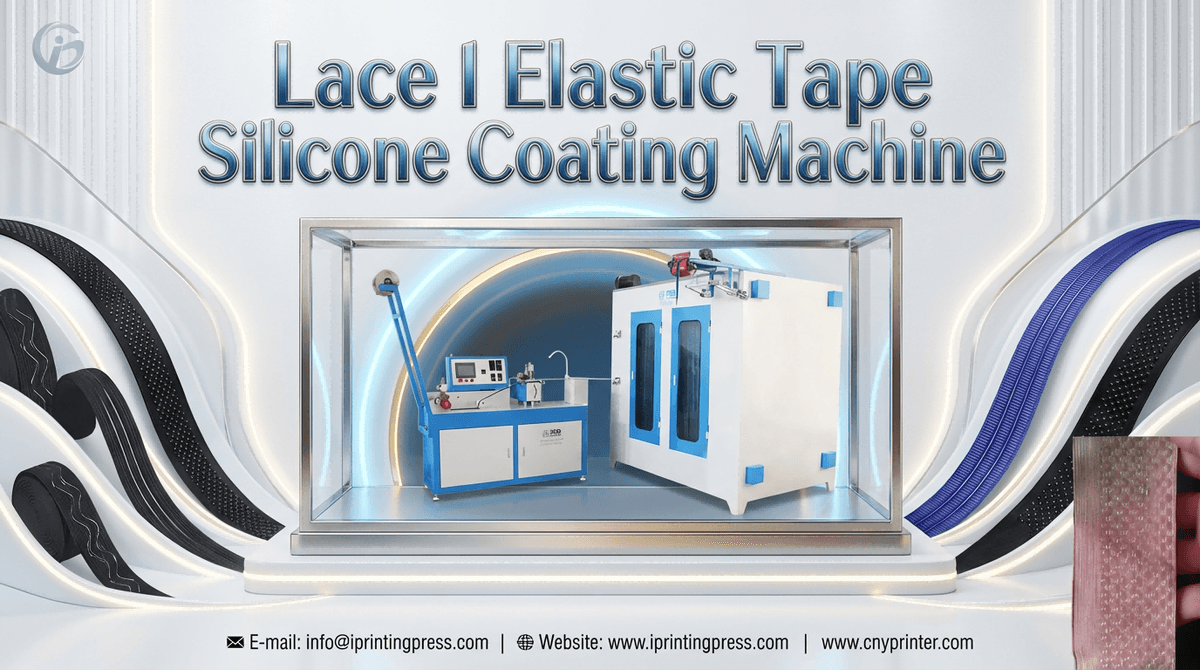
Our Elastic Tape & Lace Silicone Coating Machine Solutions
At CNY Printer, we understand that no two manufacturers have exactly the same production requirements. Some customers are developing new products and need a flexible solution for sampling, while others require a fully automated production line capable of running continuously with consistent quality.
To meet these different manufacturing needs, we offer two specialized Elastic Tape & Lace Silicone Coating Machine configurations, each designed around a specific silicone curing technology.
Single-Component Elastic Tape & Lace Silicone Coating Machine
Our Single-Component Silicone Coating Machine is designed for manufacturers using RTV-1 moisture-curing silicone.
Because the silicone is supplied ready to use, the machine focuses on achieving stable coating quality while keeping operation simple and maintenance costs low.
Typical Production Process
Unwinding → Silicone Coating Head → Low-Temperature Drying Oven (60–80°C) → Automatic Rewinding
The low-temperature drying oven accelerates surface drying, allowing the coated tape or lace to be safely rewound. After rewinding, the silicone continues curing naturally by absorbing moisture from the surrounding air until full crosslinking is achieved.
Recommended Applications
This machine is ideal for manufacturers producing:
- Product samples and prototypes
- Decorative silicone coatings
- Silicone logos and lettering
- Small-batch customized orders
- Fashion accessories
- R&D and product development projects
Key Advantages
- Simple machine structure
- Easy operation
- Lower investment cost
- Minimal maintenance requirements
- Fast product changeovers
- Suitable for frequent color changes and customized production
- For businesses entering the textile silicone coating industry, this machine provides an economical and flexible production solution.
Two-Component Elastic Tape & Lace Silicone Coating Machine
For manufacturers seeking higher productivity and superior product performance, our Two-Component Elastic Tape & Lace Silicone Coating Machine is designed specifically for RTV-2 platinum-cure silicone.
Unlike moisture-curing systems, this machine incorporates precision metering and automatic mixing technology to ensure stable production quality throughout long manufacturing runs.
Typical Production Process
Unwinding → Precision A/B Metering Pumps → Static Mixer → Silicone Coating Head → High-Temperature Curing Oven (120–160°C) → Cooling Section → Automatic Rewinding
The precision metering pumps continuously deliver Components A and B at the correct ratio. After passing through the static mixer, the silicone is evenly applied to the textile substrate and rapidly cured inside the heating oven.
The finished product exits the production line fully cured and ready for subsequent processing, significantly improving production efficiency.
Recommended Applications
This machine is widely used for producing:
- Anti-slip bra straps
- Lingerie elastic tapes
- Sportswear elastic bands
- Compression garment elastic
- Sock gripper tapes
- Silicone-coated lace trims
- Waistband elastic
- Functional narrow fabrics
- OEM production for international apparel brands
Key Advantages
- Precision A/B automatic metering
- Stable silicone mixing
- Uniform coating quality
- Excellent wash durability
- High production efficiency
- Suitable for continuous industrial manufacturing
- Consistent product quality over long production runs
For medium and large-scale textile manufacturers, this machine offers the production stability required for premium-quality anti-slip silicone products.
1. Can one silicone coating machine use both single-component and two-component silicone?
In most cases, no.
The two silicone systems cure in completely different ways and require different machine configurations.
A single-component machine is designed for moisture-curing silicone, while a two-component machine must include precision A/B metering pumps, a static mixer, and a high-temperature curing system for addition-cure silicone.
2. Which silicone offers better wash resistance?
For products that will be washed repeatedly, two-component RTV-2 silicone is generally the preferred choice.
Its platinum-cure chemistry produces stronger crosslinking, resulting in improved adhesion, flexibility, and durability after repeated washing.
3. Which silicone is better for anti-slip elastic tape?
For most industrial anti-slip applications—including bra straps, sportswear elastics, waistband tapes, and compression garments—manufacturers typically choose two-component silicone because of its excellent grip and long-term durability.
Single-component silicone is more suitable for decorative coatings and light-duty applications.
4. Is single-component silicone suitable for mass production?
It can be used for production, particularly when manufacturing decorative silicone products or customized orders.
However, for high-volume manufacturing where consistent curing speed and product performance are critical, a two-component production line is generally more efficient.
5. Why does RTV-2 silicone require an A/B metering pump?
Because the curing reaction only begins after Components A and B are mixed.
Accurate proportioning is essential to achieve complete curing and stable product quality. Automatic metering systems ensure that every batch maintains the correct mixing ratio throughout continuous production.
6. Which machine is better for lingerie and sportswear manufacturers?
For manufacturers producing:
- Bra straps
- Lingerie elastic
- Sportswear elastic bands
- Compression garments
- Functional lace trims
- A Two-Component Elastic Tape & Lace Silicone Coating Machine is generally the preferred solution due to its superior anti-slip performance, wash durability, and production consistency.
7. Can silicone colors be customized?
Yes.
Both single-component and two-component silicone systems can typically be pigmented using compatible color pastes. However, two-component systems usually provide better color consistency during long production runs, making them more suitable for OEM manufacturing and large-volume orders.
8. How do I choose the right silicone coating machine for my factory?
The best machine depends on several factors, including:
- Your primary products
- Production capacity
- Silicone type
- Wash resistance requirements
- Budget
- Future expansion plans
An experienced equipment supplier can evaluate your production goals and recommend the most appropriate machine configuration based on your specific application.
Final Thoughts
Selecting the right silicone is about much more than choosing a material—it is about building the right production process from the very beginning.
If your business focuses on sampling, decorative coatings, or small customized orders, a Single-Component Elastic Tape & Lace Silicone Coating Machine offers a simple, cost-effective solution with excellent production flexibility.
If your goal is to manufacture high-quality anti-slip elastic tapes, lingerie accessories, lace trims, sportswear elastics, or OEM textile products, investing in a Two-Component Silicone Coating Machine will provide better curing consistency, higher production efficiency, and superior long-term product performance.
By matching the silicone system to your production requirements, you can reduce waste, improve coating quality, and build a more competitive manufacturing process.
Looking for the Right Silicone Coating Machine?
Whether you're producing elastic tapes, lace trims, lingerie accessories, sportswear elastics, medical textiles, or other narrow fabrics, choosing the correct coating technology is the foundation of reliable and efficient manufacturing.
At CNY Printer, we specialize in the design and manufacture of Elastic Tape & Lace Silicone Coating Machines tailored to different production needs—from flexible sampling equipment to fully automated industrial production lines.
If you're unsure whether a single-component or two-component silicone coating machine is the best fit for your factory, our engineering team can recommend the most suitable solution based on your materials, product requirements, production capacity, and future expansion plans.
Contact us today to discuss your project or request a machine demonstration—we'll help you find the most efficient silicone coating solution for your business.